

SUSTAINABLE FINANCING
New Funding Model
Student-Centered Funding Model
The Student-Centred Funding Model (SCFM) was unveiled by President William Ruto on May 3, 2023, to address challenges facing public universities and Technical and Vocational Education and Training (TVET) institutions due to increased enrolment and inadequate funding. The funding framework phased out the Differentiated Unit Cost (DUC) system, shifting from institution-based funding to a student-focused approach, in which funding for undergraduate education is provided through Government scholarships and loans, as well as household contributions. The model delinks university placement from funding, which is determined through a Means Testing Instrument (MTI) to assess the level of financial need.
Government Scholarships
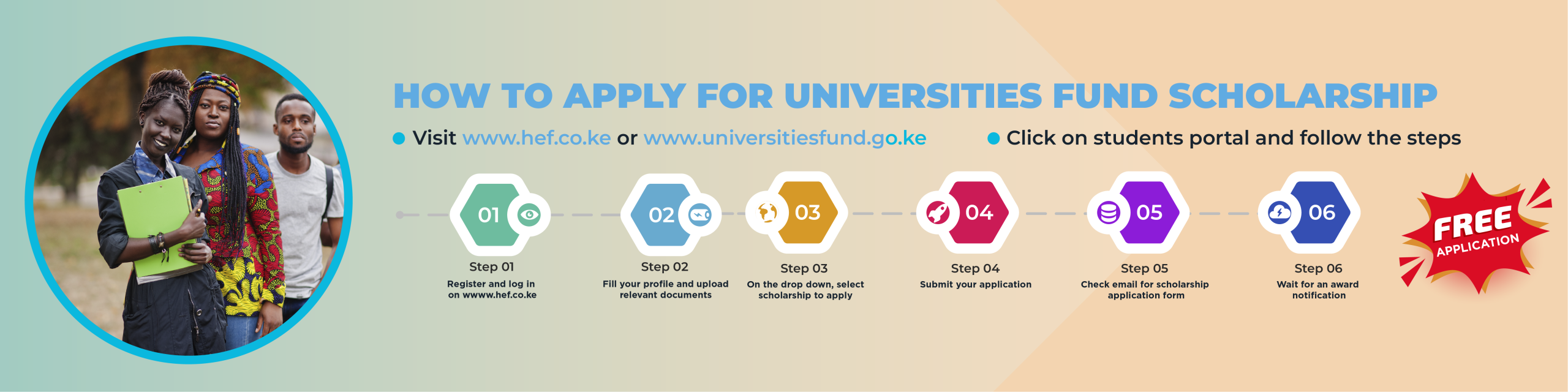
The Universities Fund will offer scholarships to students ranging from 30% to 70% based on their level of need. Any remaining deficit will be covered through household contributions and loans. Students interested in receiving scholarships must formally apply through the Higher Education Financing (HEF) portal, accessible at www.hef.co.ke. The Means Testing Instrument (MTI) tool will be utilised to assess the level of need for funding students who apply for scholarships.
Key Players
The Student-Centred Funding Model is being implemented by various Government agencies including, the Universities Fund (UF), Higher Education Loans Board (HELB), Kenya Universities and Colleges Central Placement Service (KUCCPS) and the State Department for Technical and Vocational Education and Training. The Universities Fund provides scholarships to university students, HELB offers loans, KUCCPS places KCSE graduates to higher learning institutions, while the State Department for Technical and Vocational Education and Training provides scholarships to students placed in TVET institutions.
Universities Fund Scholarships
The Universities Fund offers partial scholarships to cover tuition costs for students enrolled in public universities based on the student’s financial need. Any deficit is catered for through government loans provided by HELB and household contributions from parents or guardians. Students interested in scholarships must formally apply through the Higher Education Financing (HEF) portal accessible at www.hef.co.ke.
Since the introduction of the model in 2023, more than 400,000 students have benefited from the scholarship, with the first cohort expected to graduate in 2027. The funds are disbursed directly to public universities to cover students’ tuition fees.
Eligibility
- To qualify for the Universities Fund scholarships, an applicant must:
- Be a Kenyan citizen.
- Have been placed in a public university by KUCCPS.
- Have sat the Kenya Certificate of Secondary Education (KCSE) examination in 2022 or later.
- Submit an application through the Higher Education Financing (HEF) Portal at www.hef.co.ke
Application Portal
Eligible students can apply for Government scholarships through the Higher Education Financing (HEF) Portal at www.hef.co.ke.
The portal can also be accessed through the Universities Fund website.
Continuing students can submit their applications using *USSD 642# through the mobile phone number registered on the HEF Portal.
Benefits of the New Higher Education Funding Model
- Ensures that all eligible Kenyan students receive adequate financial support for their education.
- Promotes the provision and access to quality higher education.
- Ensures that all students are equitably and adequately supported based on their level of financial need.
- Ensures timely disbursement of funds to students through their higher education institutions.
Application requirements
Before starting your application, ensure you have the following:
- A valid email address.
- A valid mobile phone number registered in your name.
- KCPE and KCSE index numbers and years of examination.
- A recent passport-size photograph.
- Your university admission letter.
- Your birth certificate or National Identity Card.
- Your parent or guardian’s registered mobile phone number.
- Your parent or guardian’s National Identity Card number.
- A parent’s death certificate, where applicable.