
The Universities Fund has called on students, especially those from vulnerable backgrounds, to seek placement in public universities as a key step toward accessing government scholarships and ensuring a smooth transition into higher education.
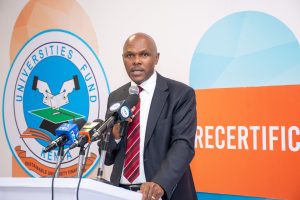
The Universities Fund Ag. Chief Executive Officer Dr. Edwin Wanyonyi explained that under the current Student-Centred Funding Model (SCFM), placement in a public university is mandatory for students to qualify for scholarships.
“The journey toward accessing scholarships begins with students completing their Form Four examinations and attaining the minimum grade required for university admission. The next step is placement through KUCCPS. Once placed, you move to the third stage, which is applying for funding for your university education,” said Dr. Wanyonyi.
Under the model, government funding comes in the form of scholarships and loans. Students placed in public universities can access both scholarships and loans, while those placed in private universities are only eligible for loans. In both cases, the remaining balance is covered through household contributions by parents or guardians.
“All students should take advantage of scholarships. It is free support from the government, and you will not be expected to pay back. This is the equity pillar of the model. It allows you to jumpstart your university journey,” Dr. Wanyonyi said.
The call comes just days before the closure of the Kenya Universities and Colleges Central Placement Service (KUCCPS) placement portal, which is expected to process applications for more than 268,000 students who qualified for university admission.
Under the Student-Centred Funding Model, students from low socioeconomic backgrounds receive the highest level of support compared to those requiring minimal or no financial assistance.
Dr. Wanyonyi noted that students must first apply through the Higher Education Financing (HEF) Portal to be considered for funding. He emphasized that awarding of funds is not automatic, but is determined by the applicant’s level of financial need.
As the government continues to push for 100 percent transition from basic to tertiary education, he noted that the Ministry of Education has capped tuition fee support at a minimum of KSh 5,900 and a maximum of KSh 75,000 per semester under the model.
“To achieve those funding levels, you must receive both a scholarship and a loan. If you fail to apply for a scholarship, then you will not qualify for the minimum fees support because the scholarship covers its portion,” he added.
Dr. Wanyonyi praised the funding model, noting that a Means Testing Instrument (MTI) is used to assess applicants fairly and objectively.
“In the Means Testing Instrument, there are several factors we consider to determine your level of need, including the primary and secondary schools you attended, the fees you were paying, your parents’ employment and income status,” he said.
Other considerations include the number of siblings in the household, disability status, and parents’ health condition. He added that the model also prioritises students who have lost one or both parents, with total orphans receiving the highest level of support.